
Can a Cryptocurrency Wallet Be Recovered With Missing Seed Words?

One of the most common misconceptions in cryptocurrency is that a wallet is permanently lost the moment a recovery phrase becomes damaged or incomplete.
While this is often true when large portions of a seed phrase are missing, there are situations where wallet recovery may still be possible.
At Token Trace, we occasionally work with individuals who have most of a recovery phrase but are missing one or more words, have damaged backups, or are unsure of the correct word order. Depending on the circumstances, technical recovery methods may help determine whether the original phrase can be reconstructed.
This article explains how missing seed word recovery works and why certain cases may be recoverable while others are not.
Understanding Seed Phrases
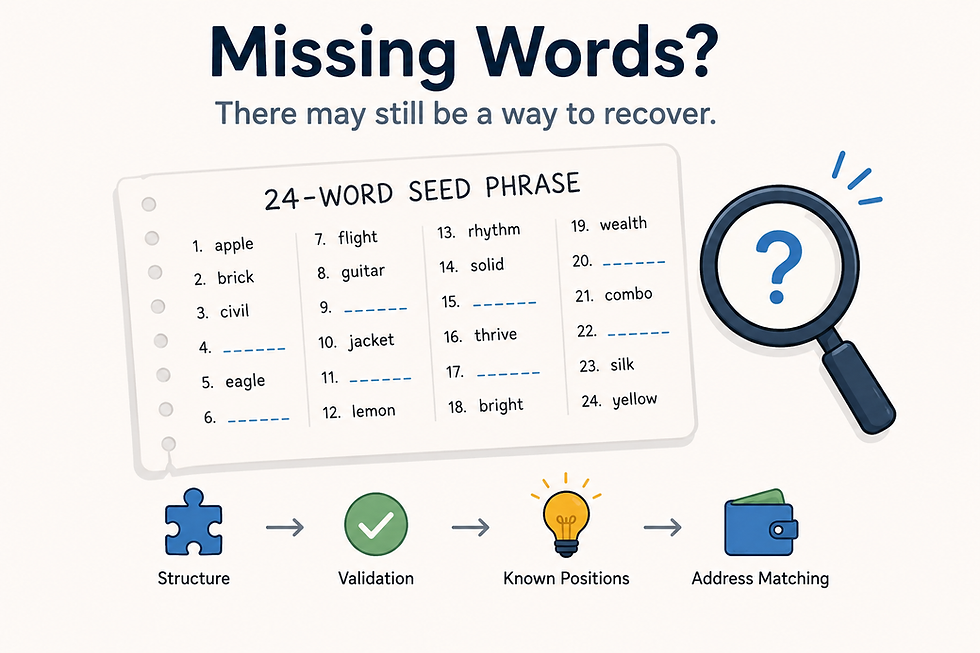
Most modern cryptocurrency wallets use the BIP-39 standard, which generates a recovery phrase consisting of either:
12 words
18 words
24 words
These words are selected from a standardized list containing 2,048 possible words.
The recovery phrase acts as the master backup for the wallet. Anyone who possesses the correct phrase in the correct order can typically regenerate the wallet and access the associated assets.
Because of this, even small mistakes can prevent access to the wallet.
Common Recovery Phrase Problems
Over the years, wallet owners have encountered a variety of issues, including:
Missing or unreadable words
Water damage
Fire damage
Faded ink
Partial photographs
Incorrect word order
Transcription mistakes
Uncertain spelling
In some cases, the recovery phrase exists but cannot be used successfully because one or more words are incorrect or misplaced.
Missing Seed Words
One of the most common scenarios involves a recovery phrase with only a small number of missing words.

For example:
A wallet owner may possess 22 out of 24 words but be unable to read the remaining two words due to damage or fading.
While this may initially appear hopeless, BIP-39 recovery phrases contain structural characteristics that can significantly reduce the number of valid possibilities.
Potential recovery techniques may include:
BIP-39 word list analysis
Checksum validation
Known word position analysis
Wallet address matching
Derivation path testing
When enough information is available, these methods can sometimes narrow a large search space into a manageable number of candidates.
Incorrect Word Order
Another common issue occurs when all words are present but their order is unknown.
This often happens when:
A user copied words onto multiple sheets of paper
Backup pages became mixed together
The phrase was transcribed incorrectly
A photo was taken without preserving sequence
Since BIP-39 phrases rely on exact ordering, even a single misplaced word can prevent successful recovery.
Depending on the number of unknown positions, mathematical and computational techniques may be used to evaluate possible arrangements and identify valid candidates.
The Role of BIP-39 Checksums
Many users are unaware that BIP-39 recovery phrases include a checksum mechanism.
The checksum acts as a validation system that helps identify whether a phrase is

structurally valid.
This means that not every combination of words is possible.
When words are missing or uncertain, checksum validation can dramatically reduce the number of candidate phrases that need to be evaluated.
While it does not guarantee recovery, it often provides an important starting point for analysis.
Why Wallet Addresses Matter
Recovery efforts become significantly more practical when a wallet address is known.
A known wallet address can sometimes be used to:
Verify candidate phrases
Confirm successful recovery
Eliminate incorrect combinations
Match derived wallet outputs
The more information available, the greater the likelihood of narrowing the search space effectively.
When Recovery May Not Be Possible

Not every case can be recovered.
Recovery becomes increasingly difficult when:
Numerous words are missing
No wallet address is known
The wallet type is unknown
The backup contains substantial errors
In some situations, the number of possible combinations becomes so large that practical recovery is no longer feasible.
Frequently Asked Questions
Can a wallet be recovered if one seed word is missing?
In some cases, yes. Depending on the wallet type and available information, a missing word may be recoverable using BIP-39 analysis and checksum validation.
What if two or three seed words are missing?
Recovery may still be possible in certain situations, particularly when word positions are known and wallet addresses are available for verification.
Can a wallet be recovered if the words are out of order?
Potentially. The feasibility depends on how many positions are unknown and what additional information is available.
What is a BIP-39 checksum?
A checksum is a built-in validation mechanism used to verify that a recovery phrase follows the correct structure.
Does knowing the wallet address help?
Yes. A known wallet address can often be used to validate candidate recovery phrases and eliminate incorrect combinations.
Final Thoughts
Missing or damaged recovery phrases do not automatically mean a wallet is unrecoverable. In certain circumstances, BIP-39 structure, checksum validation, known word positions, and wallet verification methods may help narrow potential recovery candidates.
The success of any recovery effort depends heavily on the amount and quality of information available, but understanding how these mechanisms work can help wallet owners better evaluate their options when faced with an incomplete recovery phrase.
Token Trace assists clients with cryptocurrency tracing, blockchain investigations, and select seed phrase recovery assessments involving missing words, damaged backups, and incorrect word order scenarios.
If you have an incomplete recovery phrase and are unsure whether recovery may be possible, Token Trace can assess your situation and determine whether a recovery attempt is technically feasible.


